Exercises for Obese Clients: Training Progressions to Try

While there is no single right way to train clients who are overweight or have obesity, using regressions can be an effective method to employ. The ACE Integrated Fitness Training® (ACE IFT®) Modelpromotes stability and mobility prior to movement because movement must be executed properly before integrating load. Moving too quickly to the load phase may result in joint stress or injury if faulty movement patterns are present under heavy resistance.

Functional resistance training and training for daily activities is an ideal method to ensure clients connect their exercise gains with life movements. It also helps ensure clients develop a positive connection to exercise. The key is to utilize “precursor” exercises, like the ones below, which benefit coordination, stability, mobility and motor control.

When progressing a client to the next exercise, the length of time spent on each exercise depends upon on the individual’s movement abilities. When the client demonstrates excellent movement skills, he or she can progress to the next exercise. Sets and repetitions should be based on the client’s ability and the length of the training program. Below are exercises for obese clients and different progressions that you can use.

Bend and Lift Progression

Bend-and-lift progressions are commonly seen with squats. A squat progression is given below.

Hip Bridge >

Lie on the floor with knees bent and feet flat. Lift the hips into the air and keep the arms on the floor.

Squat Up and Down from Bench >

Sit on a bench with arms positioned in front of the body. Lift the body into an upright position and return to the starting position.

Squat Up and Down From Bench While Holding TRX >

Hold TRX straps while sitting on a bench. Lift the body into an upright position while using the TRX for support. Return to the starting position.

TRX Squat >

With elbows under the shoulders, hold the TRX handles and stand upright. Lower the hips into a squat position with elbow extension. Return to the starting position.

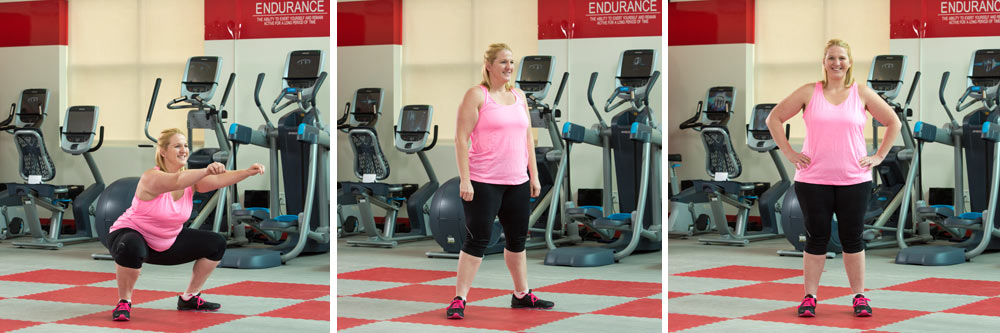
Body-weight Squat >

Stand with arms at shoulder height in front of the body. Lower the hips into a squat position and return to center.

Squat With Light Load (e.g., Medicine Ball) >

Stand while holding a medicine ball in front of the chest. Lower the hips into a squat position.

Directional Change or Split Squat Stance

Perform a squat, rotate 45 degrees, then perform another squat. Repeat.
Squat

Single-leg Movement Patterns – Forward

Single-leg movement patterns are often associated with the lunge. However, in real life, forward movement is essential and the primary forward movement is gait.

Static Lunge >

Assume a lunge stance. Lower the back knee toward the ground. Return to the starting position and repeat. Complete sets on each side.

Forward Weight Shifts >

From a standing position, step forward, load the front foot with weight and step back to center.

Forward Walking >

Stand and walk forward, concentrating on core activation and posture.

Suitcase Carries >

Place weights on the ground. Squat, pick up the weights and walk to another area.

Forward Alternating Lunges >

Stand with feet hip-distance apart. Lunge one leg forward while maintaining good upper-body posture and then return to the starting position. Alternate legs.

Body-weight Step-ups With Both Feet on Platform >

Face a plyo-box and step the right foot on the bench, followed by the left. Step the right foot off the bench, followed by the left. Complete sets on each side.

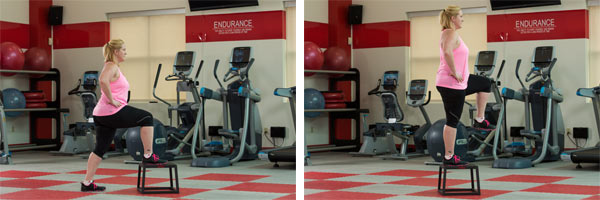
Steps-up With Hip Flexion

Stand with one foot on raised surface. Step up and raise the opposite leg to a 90 degree angle.
Step up with hip flexion

Single-leg Movement Patterns – Backward

Backward movement is essential for athletic and life pursuits.

Static Lunge >

Assume a lunge stance and lower the back knee toward the ground. Return to the starting position and repeat. Complete sets with each leg.

Backward Weight Shifts >

Begin standing and step back. Load the back foot with weight and step back to the starting position.

Backward Alternating Touch Backs >

Stand with feet hip-distance apart. Extend the leg back, touching the ball of the foot on the ground. The knees should not bend like a lunge. Return to the starting position.

Backward Alternating Lunges >

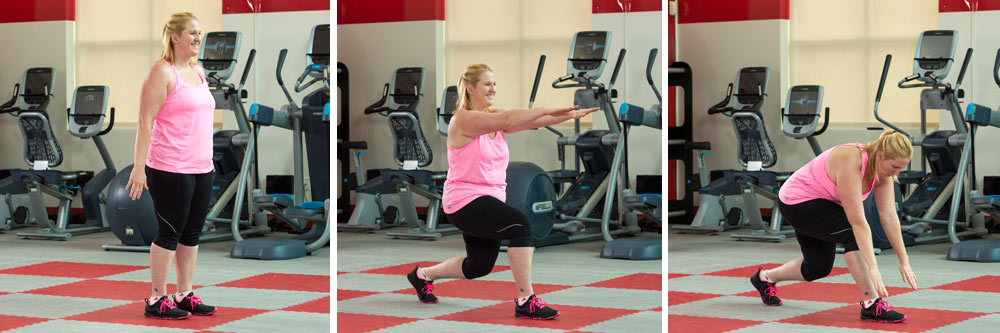
Stand with feet hip-distance apart and lunge backward, bending the knees, while maintaining good upper-body posture. Alternate legs.

Backward Lunge With Forward Hip Flexion

This exercise will help you practice one-legged balance.
backward lunge

Push Progression

A push progression is an essential movement pattern during athletic pursuits.

Smith Machine Push-up >

Adjust the Smith rack to desired height. Place the hands wider than the shoulders and perform push-ups.

TRX Chest Press >

Adjust the TRX so that the handles hang about waist height. Start with feet in a split stance. Bend and extend the elbows while maintaining stability in the torso.

Push-up Against Gravity >

Perform a push-up either on the ground or by incorporating equipment.

Push-up With Legs on Stability Ball >

Place the stability under the quads (under shins are a progression) and perform push-ups.
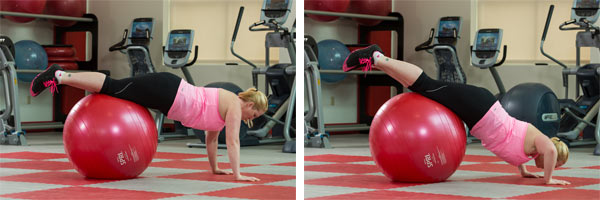
Push up on stability ball

Pull Progression

A pull progression is an essential movement pattern used to bring items toward the body. This requires adequate stability in the scapula as well as shoulder mobility.

Upright Body-weight Rows With Foam Roller Behind Shoulder Blades >

Place a foam roll against the wall and position the roll under the shoulder blades. Perform a row motion with the arms. Progress using a resistance band for a greater challenge.

Smith Machine Rows >

Adjust the Smith rack to desired height. Place the hands wider than the shoulders and perform rows.

TRX Rows >

Adjust the TRX so that the handles hang about waist height. and start with feet in a split stance. Bend and extend the elbows while maintaining stability in the torso.

Bilateral Rows >

With a resistance band or cable, position the body in either a seated or upright position. Perform rows while maintaining good posture.

Unilateral Rows With Bilateral Stance >

With a resistance band or cable machine, stand upright with feet shoulder-distance apart.

Unilateral Rows With Unilateral Stance

Position feet in a unilateral stance, bending the front leg, keeping the back leg straight, and leaning forward slightly. Perform dumbbell row with the arm opposite of the front leg. Repeat on the other side.
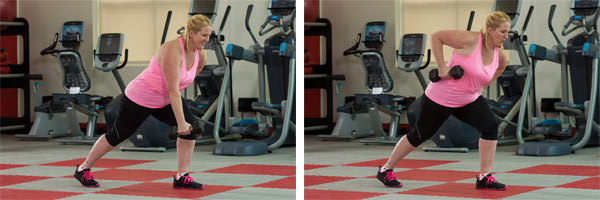
Unilateral rows

Rotational Movement

Rotational movements increase thoracic mobility, hip mobility and strength in the torso region.

Side Lunge With Torso Rotation >

Stand and lunge the left leg into a side lunge. Reach the right hand toward the left calf (rotating the torso slightly). Return to the starting position and repeat on both sides.

Standing Rotation With Resistance Band >

Stand with feet shoulder-distance apart. Hold a band in front of the chest and rotate the torso using core strength. Complete sets on both sides.

Standing Cable Machine Rotation

Stand sideways to a cable machine with your feet hip-width apart. Hold the cable handle relatively close to your body slightly below chest height, positioning your hands at the midline of your body. Engage your abdominal muscles to brace your torso. Keeping your torso vertical to the floor, pull your shoulder blades down your back without arching your low back.
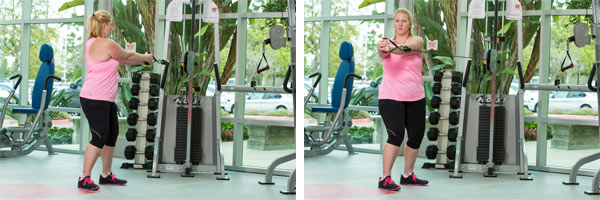

Standing cable machine rotation

How to Build a Sports Performance Fitness Program

creating a functional training program. An individualized, scientific approach to training will be more successful in improving a player’s fitness and, ultimately, his or her performance (Rhea, Kenn and Dermody, 2009). Keep in mind that athletes react to the same training stimulus in different ways, so be sure to create a detailed checklist of all variables and elements.

Before you start building the program, whether it’s for a team or individual, it’s a good idea to look at a needs analysis as part of your checklist for your athletes. This includes, but is not limited to, the following:

  • Athlete’s goals
  • Sporting position
  • Training age (coached)
  • Previous injuries
  • Length of the season(s)
  • Recovery time needed
  • Maturity
  • Contact/non-contact
  • Training days available
  • Energy systems used
  • Training background
  • Genetics
  • Movement analysis
  • Individual fitness levels
  • Recovery rate
  • Fundamental competencies
  • Preparation timeline
  • Training environment
  • Natural coordination
  • Physiological demands
  • Psychological demands
  • Competitions per cycle

Once the needs analysis has been completed, it’s best to first consider the timeline for preparation and then work toward honing the finer details of the program, such as movement patterns, resources available, exercise choices and sets/repetitions. It is also important to consider having a plan B and a plan C, as things don’t always go according to expectation. Being adaptable as a trainer or coach is fundamental to cultivating successful, strong and healthy athletes.

Here are the essential scientific training principles to consider (Jeffreys and Moody, 2016):

  • Adaptation or accommodation:Every time athletes train, changes take place that make them more effective and efficient. Dr. Hans Selye’s GAS (General Adaptation Syndrome) states that stress causes a temporary reduction in performance/function, which is followed by adaptation, which improves function and performance (Selye, 1978). Trainers should consider changing up their selection of exercises every few weeks, because the body adapts and needs variety to be consistently challenged.
  • Rest and recovery: Although it’s important that the training load is progressive, it is equally important that rest and regeneration are programmed and planned. Rest and recovery between sets, between exercises and between workouts should be planned and strategically measured to avoid burnout or injury. Keep rest periods between sets and exercises to approximately 3060 seconds, depending on the client’s goal and fitness level. At least one day off per week is recommended to avoid burnout; however, the individual should listen to his or her body and, if necessary, take additional days off.
  • Overload: For fitness to improve, an athlete must continually boost the work he or she performs. Here are some examples of how to increase intensity without changing the exercise:
  • Reducing the recovery time
  • Adding more weight
  • Increasing manual resistance
  • Expanding range of motion
  • Quickening concentric movements
  • Adding cognitive awarenesscomponents
  • Adding repetitions
  • Performing additional sets
  • Increasing time under tension
  • Including balance components
  • Performing single- versus double-extremity movement
  • Specificity: Athletic focus should be specific and the training a player performs must relate to the demands of the competition. A player’s horizontal power potential is an example of specific conditioning for the player. The key point of this principle is that the player’s training should be guided by the demands of the sport in general and his or her position in particular.
  • Individuality: If two athletes perform the same exercise at the same level of fitness, it may be more challenging for one more than the other. Know your athlete—your approach to his or her program should not be “one-size-fits-all.”
  • De-training/reversibility: Any prolonged time off of training will be accompanied by a decline in fitness levels. Therefore, a reconditioning program should be undertaken before a player returns to full training or competition.
  • Generality: Athletes who are at a relatively young training age will improve their fitness across a range of fitness components by engaging in general training (Bompa, 1999). A general training program is likely to produce positive adaptation in a player or squad if they are beginning a training program. As players mature in training age, it is probable that the “general” training program will not be as effective in growth and development (Bosco, 1999). Clients who have not had formal resistance and cardiovascular experience should be introduced to a variety of training, including flexibility, power components, endurance training and agility, to improve their fitness levels. However, clients who have had two or more years of training will require more goal-specific training.
  • Variation/variability: Adjusted responses to rigorous training loads are demonstrated during successive unloading periods. Additional training effects are realized through planned training methods and means throughout a cyclic basis (Jeffreys and Moody, 2016). Changing up the training loads (volumes, repetitions, sets, etc.) help to create variation in a training program. This can be done on a week-by-week basis (undulating) according to how the client is reacting to the training stimuli or it can be done in a linear fashion.

Once you have thoroughly reviewed the most significant factors including the principles of training, you can then begin to work through the microcycles, or individual training days, which may consist of multiple sessions. Each training session should be comprised of the little building blocks that lead to the achievement of the athlete’s goals. These building blocks may include all three planes of motion, range of motion, exercise equipment choices, single- versus double-extremity movements, recovery time and metabolic-conditioning sessions.

As a reminder, training sessions are not meant to merely provide the athlete with a good workout, but rather to set up the athlete for long-term success. If these pointers are applied, these training-program recommendations will give athletes the edge they need to succeed.

Exercise Your Way to Stronger Bones

Often overlooked in program design is the importance of incorporating exercises for maintaining bone health. Bones function in the body to provide structural support, protect internal organs, enable movement, store minerals and produce blood cells. Therefore, strong and healthy bones are essential to maintain these functions for overall health and well-being.

Bone is continuously being modified through bone breakdown (known as bone resorption) or bone formation in response to various stimuli including mechanical loading, nutrition, hormones and nutrient needs. This process allows the body to remove damaged bone as well as repair and preserve bone tissue (Kini and Nandeesh, 2012). If there is a balance between the amount of bone formation and breakdown, bone mass will be maintained; however, as we age, this balance shifts as bone resorption begins to exceed bone formation, resulting in a loss of bone over time (Demontiero, Vidal and Duque, 2012).

Bone mass peaks between the ages of 25 and 30 years and then gradually declines over time, with accelerated losses occurring in women after the onset of menopause (O’Flaherty, 2000). Some contributing factors to the loss of bone over time are increased sedentary activity, low calcium and vitamin D levels, and hormonal changes, especially the loss of estrogen during menopause, which plays a large role in maintaining bone (Demontiero et al., 2012). Greater losses in bone over time can lead to osteoporosis, a disease characterized by low bone mineral density, loss of bone tissue, and increased risk for fractures.

Exercise to Prevent Bone Loss

Exercise can be an effective way to combat these age-related losses in bone, as the mechanical load caused by exercise has been found to improve bone mass and bone mineral density (Turner, 1998). To build strong bones, the following types of training should be incorporated into your clients’ exercise program:

  • Resistance Training: Resistance exercises performed with machines, free weights, bands or body weight can have positive effects on bone health. To gain the most benefits from a resistance training program, especially for postmenopausal women who are more susceptible to bone loss, one systematic review article suggests to complete a high load training program three to five days per week at an intensity of 70 to 90% of the client’s one repetition maximum (1RM) for two to three sets of eight to 12 repetitions for a duration of at least one year (Zehnacker and Bemis-Dougherty, 2007). In addition, each exercise must target the specific bone sites that you are looking to improve (Zehnacker and Bemis-Dougherty, 2007; Zhao, Zhao, & Xu, 2015). Because the hip, spine and forearm are most susceptible to fractures due to osteoporosis, weighted exercises that specifically involve action at those joints or regions should be performed. Suggested exercises for improvements in these areas include a weighted squat, leg press, leg extension, hamstring curl, hip extension, back extension, bench press, shoulder press, biceps curl and triceps extension.
  • High-impact Training: High-impact exercises that include movements such as jumping, skipping or hopping can be beneficial for preventing bone loss at the hip and spine regions. Greater benefits have been found with exercise programs that incorporate a combination of resistance training with high-impact exercises (Zhao et al., 2015). Impact exercises can include jogging, running, jumping rope and box jumps. Weighted vests can also be incorporated to add additional resistance to these movements. While high-impact training can be useful for building stronger bones, it may not be safe for those who already have osteoporosis and are at risk for bone fractures.
  • Low-impact Weight-bearing Training: Low-impact weight-bearing exercises such as walking, using the stair climber or low-impact aerobic fitness classes may be a safer alternative for those who are unable to do high-impact training due to osteoporosis or other conditions. While low-impact training alone may not be sufficient in preventing bone loss, low-impact training programs such as tai chi can reduce the risk for falls and thus prevent fractures. In addition, low-impact training can be combined with resistance exercises for added benefits for bone health